
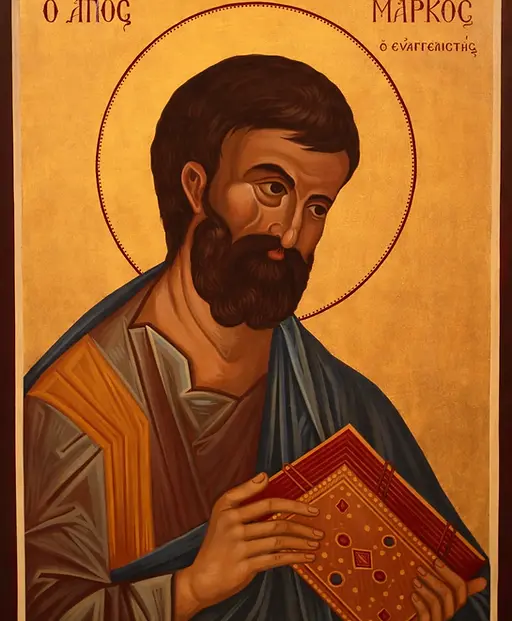
Saint Mark the Evangelist, also known as John Mark, was one of the Seventy Apostles and the author of the Gospel according to Mark. He is honoured as a close companion of the Apostles Peter, Paul, and Barnabas, and as the founder of the Church in Alexandria. His feast day is celebrated on 25 April in the Orthodox Church.
25 April 2026
Apostle and Evangelist
Saint Markos
Early Life and Connection to the Apostles
Saint Mark was born in Jerusalem to a Christian family. His mother, Mary, owned a house that became an important meeting place for the early Christian community. According to the Acts of the Apostles, the faithful gathered there for prayer, and the Apostle Peter went there after being miraculously released from prison (Acts 12:12).
Church tradition also associates Mark’s family home with several important events in early Christian history. It is believed by many that this house may have been the Upper Room, where Christ celebrated the Mystical Supper with His disciples and where the Apostles gathered on the day of Pentecost.
Mark was closely related to Saint Barnabas, who was his uncle, and through Barnabas he became involved in missionary work. He accompanied the Apostles Paul and Barnabas on their missionary journeys and witnessed many of the early spread of Christianity.
Missionary Work
Saint Mark travelled widely in the service of the Gospel. He journeyed with Saint Paul and Saint Barnabas to Cyprus, where he witnessed the conversion of many people and the defeat of the sorcerer Elymas through the power of God (Acts 13:6–12).
Later he returned to Jerusalem and eventually travelled to Rome, where he worked closely with the Apostle Peter. The early Church Fathers testify that Mark carefully recorded the preaching of Peter, preserving his teaching about Christ.
From Rome, Mark travelled to Egypt, where he founded the Christian Church in Alexandria, one of the most important centres of Christianity in the ancient world. There he established a Christian community and is also credited with founding the famous Catechetical School of Alexandria, which later produced great theologians such as Clement of Alexandria and Dionysius of Alexandria.
Saint Mark also composed a liturgical form used by the Christians of Alexandria, demonstrating his deep commitment to the worship and spiritual life of the Church.
The Gospel According to Mark
Encouraged by Christians in Rome, Saint Mark wrote his Gospel in Greek, recording the message of salvation in Jesus Christ. Many early Christian writers explain that Mark’s Gospel reflects the preaching and witness of Saint Peter.
His Gospel emphasises the actions and power of Christ, presenting Jesus as the suffering Messiah and Son of God. It highlights Christ’s miracles, authority over evil, and His call to discipleship.
A central theme of the Gospel is that the power of God accomplishes what is humanly impossible, and that those who follow Christ must take up their cross in faith and obedience.
Martyrdom in Alexandria
Saint Mark eventually returned to Alexandria, where his preaching converted many people. One of his early converts was a man named Ananias, whose crippled hand the Apostle healed. After his conversion, Ananias became a bishop.
As Christianity continued to spread, opposition from pagan groups increased. During one of the Church services that Saint Mark was leading, hostile pagans seized him. He was beaten, dragged through the streets, and imprisoned.
While in prison, Christ appeared to him and strengthened him for the sufferings that lay ahead. The next day he was again dragged through the streets by the crowd. Exhausted and wounded, Saint Mark prayed:
"Into Your hands, O Lord, I commend my spirit."
With these words he gave up his soul to God.
Burial and Relics
After his martyrdom, Christians reverently buried Saint Mark in Alexandria. A church was later built over his tomb.
Centuries later, during periods of persecution in Egypt, his relics were transferred to Venice in the ninth century, where they remain today in the Basilica of Saint Mark.
Iconography
In Christian iconography, Saint Mark is symbolised by a lion, one of the four living creatures described in the visions of the Prophet Ezekiel and the Book of Revelation.
The lion represents the royal dignity and power of Christ, which is strongly emphasised in Mark’s Gospel.
Icons often depict Saint Mark holding a Gospel book, representing his role as the Evangelist who faithfully recorded the teachings of Christ.
Legacy
Saint Mark’s work helped establish one of the earliest and most influential Christian communities in the ancient world. The Church of Alexandria became a centre of theological scholarship and missionary activity for centuries.
Through his Gospel and his missionary labours, Saint Mark continues to guide Christians toward a deeper understanding of Christ and faithful discipleship.
The Church honours him as an Apostle, Evangelist, teacher, and martyr, whose life demonstrates courage, humility, and unwavering devotion to the Gospel.